
String and Pick Interaction

Material
In a pick, the material is one of the fundamental design elements, as it determines much of the mechanical behaviour during interaction with the string. Flexibility, stiffness, Friction, wear resistance and dynamic response depend significantly on the properties of the material used.
Many materials are used in pick production, including nylon, polycarbonate, celluloid, acetal resins and other engineering polymers, each with different physical and mechanical properties. The choice of material affects how the pick deforms during contact with the string, how quickly it returns to its original shape and the type of interaction that occurs during String Release.
However, the material alone does not determine the behaviour of the pick. Its properties interact with geometry, thickness, profile and overall design, all contributing to the dynamic behaviour of the pick during performance.
There is therefore no single best material, but rather the most suitable material for the characteristics desired and for the type of use for which the pick has been designed

Thickness
In a pick, thickness is one of the main geometric characteristics and influences mechanical behaviour during contact with the string. With the same material and shape, a different thickness changes the pick’s response to stress, resulting in different flexibility, resistance to deformation and String Release.
In general, a thin pick tends to flex more easily while playing, while a thicker pick offers greater resistance to deformation. Thickness therefore affects the amount of energy the pick can store and return during contact with the string, contributing to the dynamic behaviour of the interaction.
The effects of thickness also depend on the material used. Two picks with the same thickness but made from different materials can have very different mechanical responses
Thickness alone does not determine the behaviour of the pick, but always works in combination with the material, geometry and overall design.
Elasticity
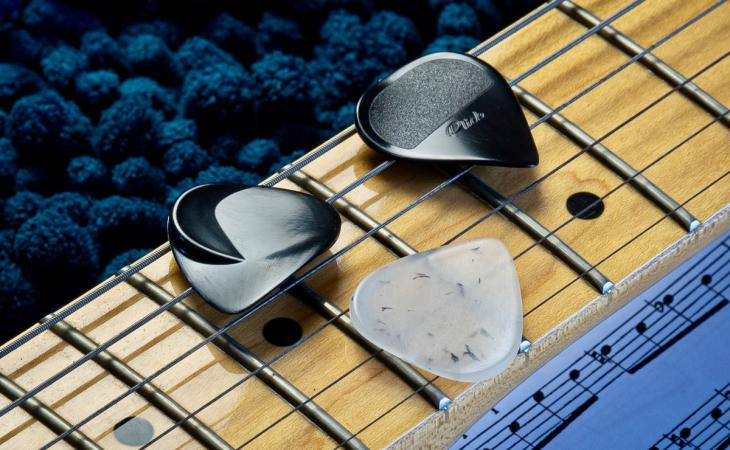
In a pick, elasticity is the ability of the material to deform during contact with the string and then return to its original shape.
Elasticity should not be confused with so-called shape memory. In technical terms, it is more accurate to speak of elastic recovery: the ability of a material to fully recover its geometry after a deformation that remains within its elastic range. Different materials may therefore show the same degree of elasticity but a different ability to recover their original shape when subjected to high or repeated stress.
This distinction is particularly important in thin picks. Cellulose acetate, commonly known as celluloid, is highly appreciated for its comfort, pleasant feel and sound characteristics, generally described as warm yet rich in harmonics. In thinner gauges, however, it has lower elastic recovery than other materials and greater fragility. Under particularly high stress, it may therefore deform permanently or break, especially during energetic strumming.
In normal pick use, these conditions rarely occur, as the deformations generated during contact with the string are generally limited. Elasticity and elastic recovery remain fundamental characteristics in pick design and must be evaluated together with material, thickness and overall geometry
Profile
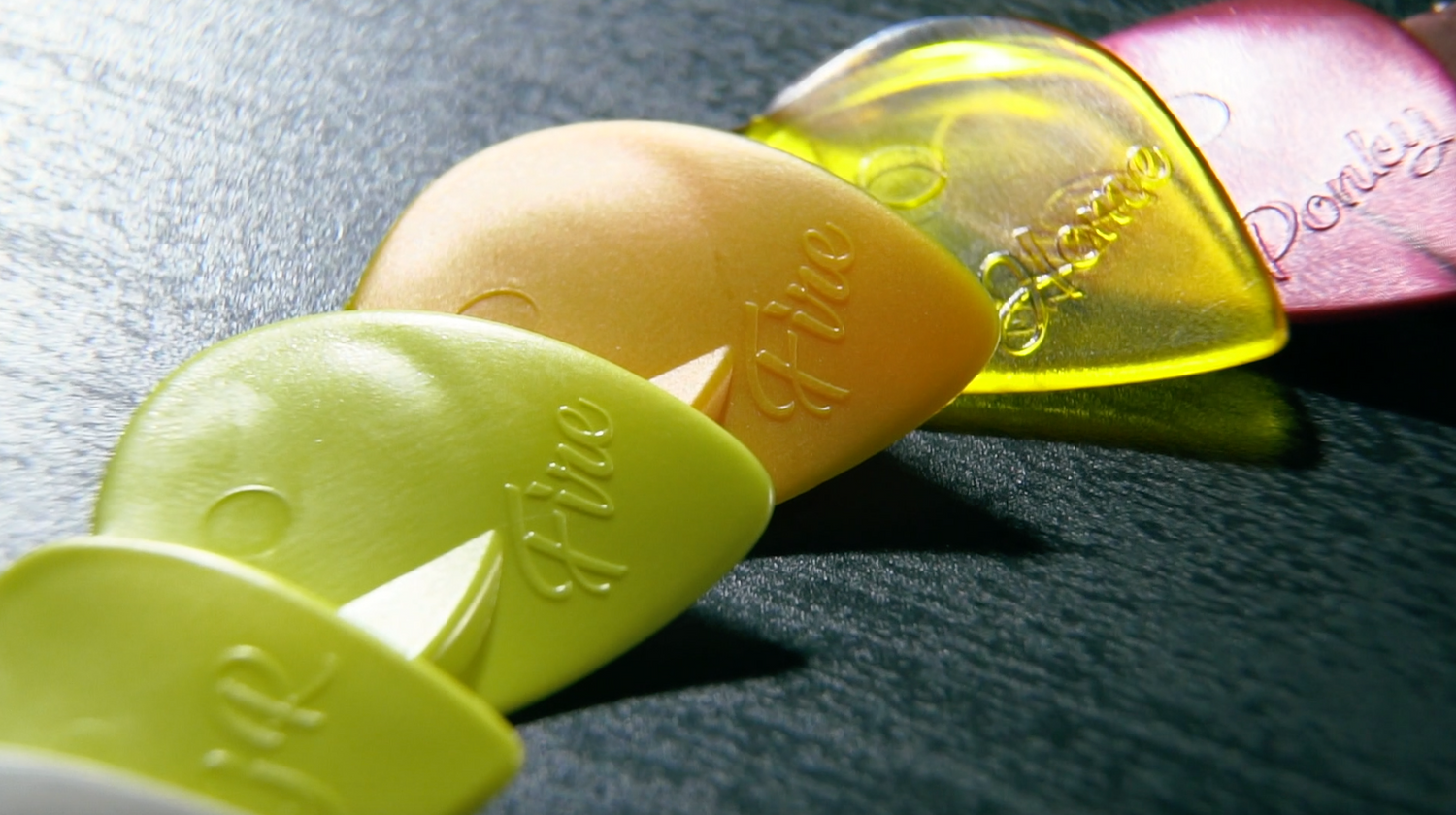
In a pick, the profile identifies the geometry of the edge that comes into contact with the string. The shape of this surface influences how the string glides over the pick, helping to determine Glide, control and response while playing.
In general, a more rounded profile tends to promote smoother string movement over the pick, while a less curved profile usually provides a greater sense of control and a more direct response during contact with the string. The choice of profile is therefore a balance between playing fluidity and response precision.
In thicker picks, it is possible to create a bevelled surface, meaning an angled surface formed along the edge of the pick. In this case, the string does not glide only over the rounded edge, but also over the bevelled surface, reducing resistance during String Release.
The presence of a bevelled surface promotes greater Glide and fluidity of movement and helps reduce the Transient generated when the pick comes into contact with the string. The profile is therefore one of the most important design elements in determining the dynamic behaviour of the pick during performance
Helical Profile
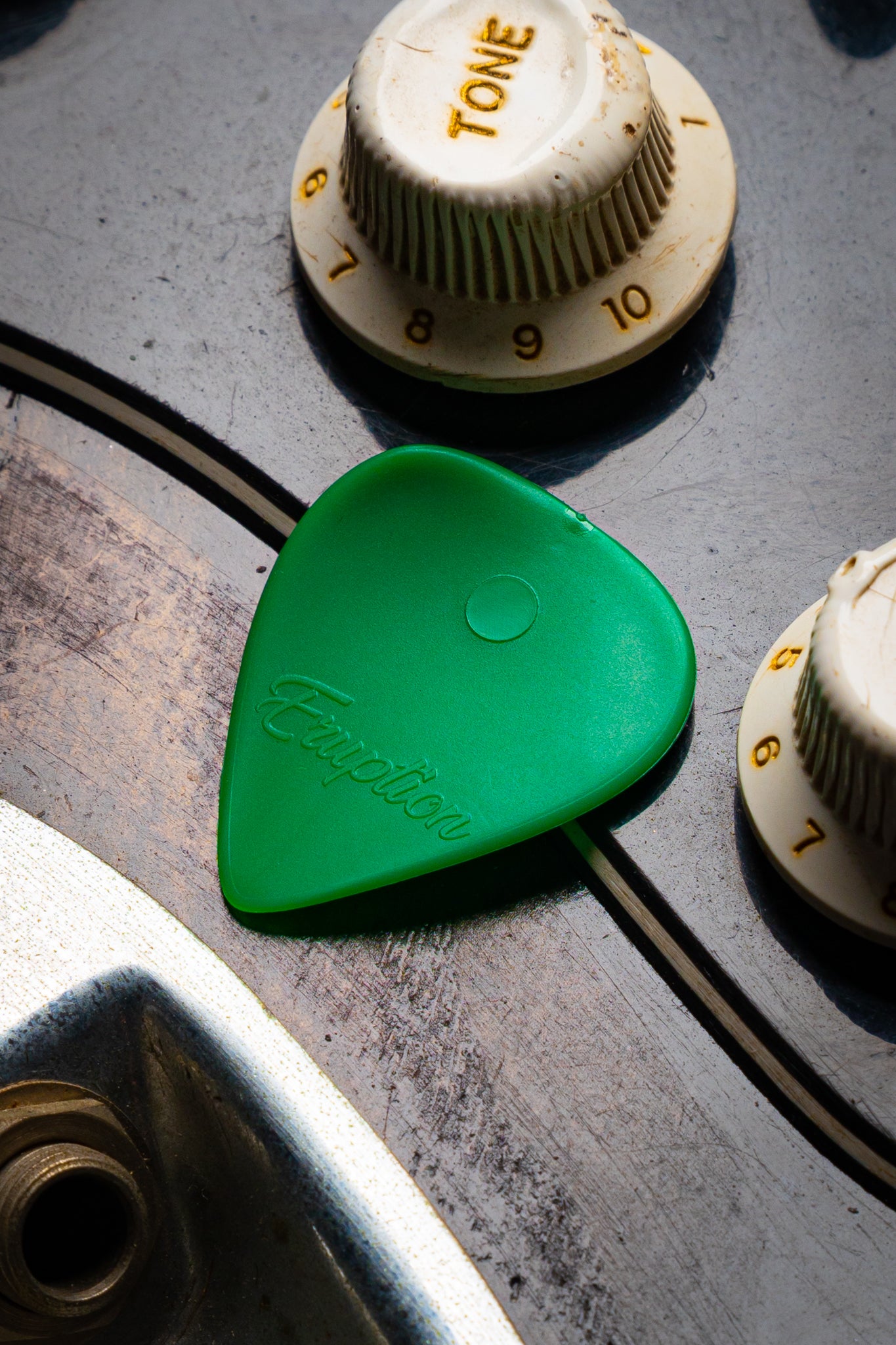
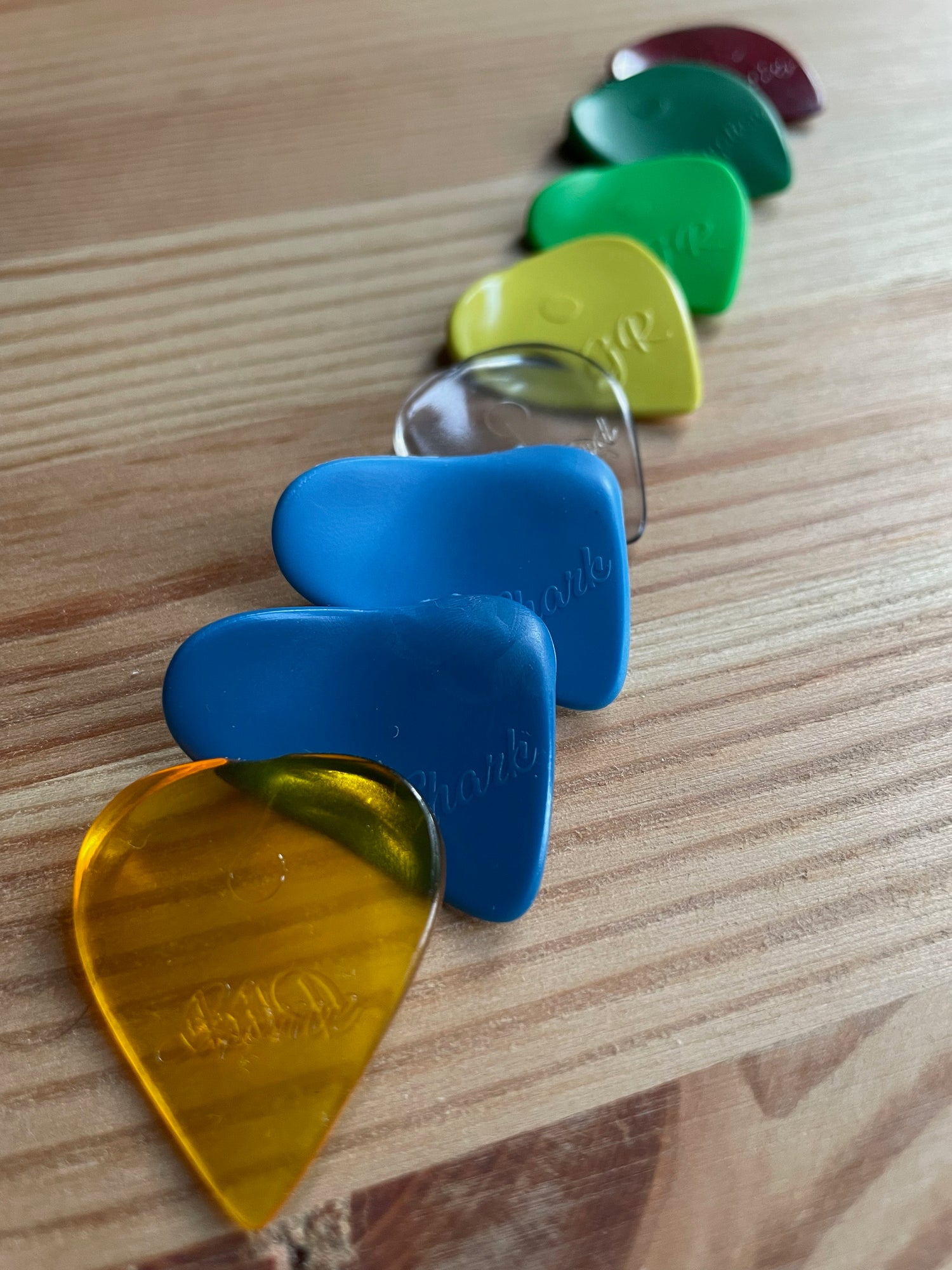
The different response of the Helical Profile is linked to the elastic behaviour of the string during String Release. When the pick moves the string away from its resting position, the elastic restoring force tends to bring it quickly back to its initial position.
If the Helical Profile has a slightly convex surface relative to the direction of string movement, this force encounters less resistance during release, encouraging the string to glide over the pick and generating a greater feeling of fluidity and Glide.
Conversely, a slightly concave Helical Profile offers greater resistance to the movement of the string during release. The string therefore tends to remain in contact with the pick for a slightly longer time, increasing the feeling of control and allowing the musician to manage attack and picking dynamics more precisely.
The Helical Profile is therefore not an aesthetic feature, but a precise design choice that uses the elastic behaviour of the string to modify the way it separates from the pick and, consequently, the feeling of Glide or control perceived while playing
Friction
In a pick, Friction is the resistance generated during contact and sliding of the string over its surface. Friction determines the exchange of energy between string and pick during interaction and is one of the main factors influencing the pick’s sound behaviour.
The amount of Friction depends on the overall design features of the pick. Material, thickness, profile geometry, any Helical Profile and surface finish all contribute to determining the resistance the string encounters as it moves.
Greater Friction causes greater dissipation of the energy accumulated by the string during contact with the pick. Since high-frequency components are generally the first to be attenuated, higher Friction tends to modify the harmonic content of the sound, favouring a response generally perceived as softer or warmer. Lower Friction, on the other hand, allows more energy to be preserved in the higher harmonic components, contributing to a brighter and more defined response.
Glide
In a pick, Glide is the ease with which the string slides over its surface during contact. It is a characteristic directly perceived by the musician and is the result of the interaction between the elastic behaviour of the string and the mechanical and geometric characteristics of the pick.
The feeling of Glide mainly depends on the Friction developed as the string moves over the pick. It is influenced by material, thickness, elasticity, stiffness, profile geometry and any Helical Profile, all of which determine the resistance opposed by the pick to the movement of the string.
A more elastic pick tends to flex during contact with the string, reducing the resistance opposed to its movement. The string therefore encounters less Friction while sliding, generating a greater feeling of fluidity. Conversely, a stiffer pick generally offers greater resistance to string movement, favouring a stronger feeling of control.
Glide is therefore not an independent characteristic, but the result of the balance between material, geometry and mechanical behaviour of the pick during interaction with the string.

Tip and String Release
The tip is the terminal part of the pick and is the element that determines String Release at the end of its movement over the profile. The way the string separates from the pick directly influences harmonic content, dynamics and the character of the attack.
A thin and rigid tip tends to release the string more sharply, preserving a greater amount of high-frequency harmonics and contributing to a bright and incisive response. A more rounded or more deformable tip, on the other hand, accompanies the release more gradually, generally favouring a softer sound.
The behaviour of the tip also depends on the elasticity of the pick. If the material and geometry allow the pick to deform without losing control of the string, during release it returns part of the accumulated elastic energy. The musician perceives this phenomenon as a slight additional push on the string, often intuitively described as a small “snap”, which can contribute to richer harmonic content and a quicker response.
String Release is therefore the result of the interaction between tip, elasticity, stiffness and pick geometry, elements that together determine the final behaviour during the stroke

Transient
In a pick, the Transient is the initial phase of the sound generated at the moment the string is released. It is the moment when the character of the attack is defined and many of the timbral characteristics immediately perceived by the listener are determined.
The Transient does not depend on a single element of the pick, but is the result of the interaction between material, thickness, elasticity, stiffness, profile, Friction and String Release. Each of these factors contributes to determining how energy is transferred to the string and distributed between the fundamental frequency and its harmonics.
A fast Transient rich in harmonics is generally perceived as bright, defined and incisive. A more progressive Transient tends instead to produce a softer and more controlled attack. Neither condition is better in absolute terms: both are the result of precise design choices aimed at achieving a specific sound response.
The Transient is therefore the synthesis of the dynamic behaviour of the pick during interaction with the string and represents the meeting point between mechanical design and musical result
Un plettro ergonomico per ogni strumento
-

Picks for electric guitar
Find the perfect pick for your electric guitar: ergonomic, durable picks with...
-

Picks for acoustic guitar
Discover the ideal ergonomic picks for acoustic guitar: warm tone, comfort, and...
-

Picks for bass
Ergonomic bass picks with a curved profile for power, stability, and deep...
-

left handed picks
Ergonomic picks for left-handed players with a reversed curved profile to ensure...


